



Firearms Lubrication Reality Check
(Hydrodynamic vs Boundary vs Dry-Film, Plus Heat + Water Behavior)
FireClean had its backside handed to them from a public relations perspective after the wake of what I now refer to as LubeGate 2015. For many gun owners this was shocking news when Vuurwapenblog.com provided data indicating that a spectral analysis noted significant similarities between FireClean and canola oil — ohh no!!!
What most people tend to leave off the headline is that Vuurwapenblog is the only editor which had conducted a long term one year “gumming” storage test of FireClean which the lube passed. He also went on to note that he still uses and supports the use of FireClean even after his report and published analysis. The kicker is that allegedly as of March 2016 FireClean is now suing this editor for defamation and slander — this is not the way to win hearts and make friends.
What more of the republishers of the Vuurwapenblog’s analysis miss is that even if FireClean is predominantly canola oil, it’s still a legitimate gun lube, so I believe the lube has been unfairly treated by the media. After all, none of the gun lube we buy is much more than some type of basic wax, vegetable, or petroleum based lube. Not to intentionally pimp a fellow writer’s site even more, however he now has a ton of spectral analysis plus the totally moronic public relations FireClean has delivered in response to his original analysis — it’s worth a trip over there to read through his posts.
Don’t take my word for it: vegetable based lubes are still awesome. A professional group of corrosion nerds called the National Association of Corrosion Engineers published a paper and study which stated:
“Recently, the use of vegetable oils and their esters has been found to offer many similar properties to their petroleum derived counterparts.”
— NACE, 2010
The paper tested many perspectives of corrosion with a variety of vegetable based lubes and found they performed similar to standard petroleum lube. If FireClean is vegetable based, it would seem that it really does not matter at all. See the sleep-inducing NACE paper here (if you’re having trouble falling asleep, it’s basically NyQuil in PDF form).
The $15 Bottle Myth (and Why You Don’t Need Tactical Unicorn Tears)
Many firearms owners are conditioned to think that gun oil can only come in a $15 4oz bottle, but the reality is that pretty much any lube will work short term — any lube. Long term storage and operation in very harsh environments is a different lubrication requirement completely requiring a corrosion protectant additive and acidically neutral lube.
The personal question I ask all readers is:
“Do you operate in such a hardcore environment and drive your firearms so hard that a WD-40 or quart of Mobil 1 automotive oil will not satisfy any lubrication need you might have?”
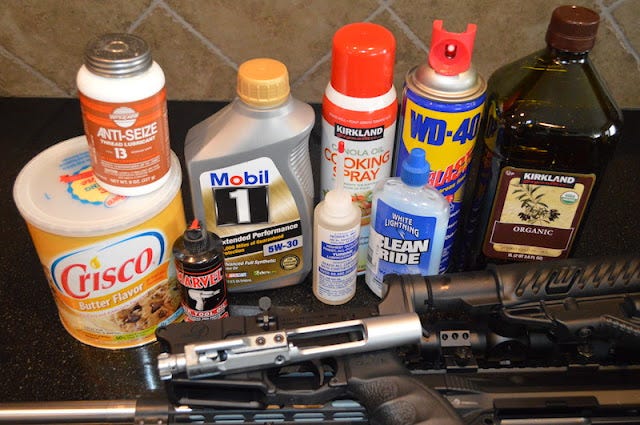
I do not — and WD-40 or Mobil 1 works fine for all my general purpose firearm cleaning, lubrication and storage needs, as does Marvel Mystery Oil, 3-in-1, Norvey Turbine Oil and a host of other general purpose lubes.
People will say that “lube is lube” — however that is not the case. KY Jelly for instance is not a good gun lube, but then again Mobil 1 is not recommended for fornication. When it comes to firearms, an aggressive rust and corrosion inhibitor is a required additive to any oil you expect to prevent surface damage.
Too thin and oil on firearms runs off, then dries off and ultimately leaves your firearm unprotected. Conversely thick grease is a pain in the butt to apply/remove and when cold can in some cases actually lock up the weapon. There is a happy medium of oil weight, viscosity, and corrosion resistance, but there are a ton of lubricants that meet all those criteria. Some work better than others for a specific need. It is important to note that corrosion inhibitors can be properly suspended and applied in either water or oil lubricant bases.
If you are assembling handguns and want to assure there is no potential what-so-ever of a locked or gummed up slide from extended long term storage, you may want to use something like Anti-Seize like Glock does. Long term gun storage may require a heavy grease or heavy oil or wax based protectant. Water displacement is another lube trait as well. Some lubes are also pretty good solvents and provide a decent one shot clean, lubricate, and protect. This category is known generally as CLP lubricants. Within that general purpose lubrication category, a blind man in the lubrication aisle at Ace Hardware could not make a poor decision for gun lubrication.
Lubrication Types (Reality, Not Marketing)
There are two primary lubrication regimes relevant to firearms:
Hydrodynamic lubrication
Liquid oil film separates metal surfaces
Boundary lubrication
Solid additives (wax, ceramic, graphite, PTFE, copper) fill micro-pores and carry load
There is also a third category that matters for firearms:
Dry-film / bonded lubricants
Minimal liquid, surface-bonded protection (this is where Sentry Solutions lives)
Hydrophobic vs Hydrophilic (Why Your Gun Rusts Even When You “Oiled It”)
Here’s the part most gun-lube marketing conveniently ignores:
Hydrophobic lubricants repel water (good — water can’t hang out on the metal)
Hydrophilic lubricants absorb/hold/emulsify water (bad — moisture camps out and starts corrosion)
Firearms strongly prefer hydrophobic behavior, especially if you sweat on guns, hunt in humidity, shoot corrosive ammo, or live anywhere that isn’t a desert.
Real-World Abuse Testing (Because I’m Not Normal)
Over the years, I have tested a number of typical and non-typical lubes just to see how they work. Note that I am not recommending all of these lubes, but a few I really like. I have a raw naked un-anodized ASA 5.45x39 AR build which fires exclusively corrosive ammo. I should see some corrosion, correct? Nothing I tested on this build delivered any signs of corrosion and I treated this rifle really badly waiting at least 1–2 weeks between each cleaning.
One of the rather unforgiving platforms on lubricants are the insanely dirty semi-auto .22LR pistols — my preferred lubes are wax based because they clean up faster and last longer. Let’s look at a few lubes I have tested and supply some recommendations based on nothing more than my un-scientific opinion and experience.
WORKABLE LUBE OPTIONS
Cooking Vegetable Shortening
When I tested this it thinned very quickly but was frankly a little messy to apply and drippy after the gun heated up — but held up really well. It is a great lube if you have nothing else, however the big shortcoming is that there are zero rust inhibitors. Use this and your gun will rust over time. Vegetable based lubes will also go rancid after expiration, so expect an off scent after about a year. Butter flavor rocks.
Lube Type: Hydrodynamic
Rust Inhibitors: No
Hydrophobic vs Hydrophilic: ❌ More hydrophilic than you want
Operating Temp: ~32°F–300°F
Special: Super freaking cheap and can even smell like cookies if you use the butter flavor.
Canola Cooking Spray
This worked awesome, and was super easy to apply. I really liked this lube and it stayed put and lasted quite a while after a couple light coats. Clean up was also very easy which typically only required a soft rag wipe down. Again there are no rust inhibitors and there is an expiration date, so you are taking chances with rust and smell.
Lube Type: Hydrodynamic
Rust Inhibitors: No
Hydrophobic vs Hydrophilic: ❌ Hydrophilic tendencies
Operating Temp: ~20°F–400°F
Special: Cheap and easy spray can application.
Virgin Olive Cooking Oil
This is a good vegetable based lube which is good on toast as well, however it is not pH balanced which means the acidity will attack gun finishes over time. The oil will eventually go rancid. Interestingly olive oil does seem to have about the perfect consistency for a gun oil.
Lube Type: Hydrodynamic
Rust Inhibitors: Antioxidants (sort of)
Hydrophobic vs Hydrophilic: ❌ Not ideal around moisture
Operating Temp: ~32°F–375°F
Special: Good on toast, frying meat balls, and a great workable lube in an emergency.
Renaissance Wax
Not really a lube, however it is a great example of a specialized protectant designed to prevent rust and corrosion on metal even with significant hand contact and environmental exposure. Perfect for swords and those top end collector guns that live in a safe. Not a lubricant. Carnauba wax does a pretty good job too.
Lube Type: Not a lubricant
Rust Inhibitors: Yes
Hydrophobic vs Hydrophilic: ✅ Strongly hydrophobic
Operating Temp: 300°F+
Special: Won’t stain/discolor, acid neutral, water/alcohol resistant, museum preferred.
Vaseline
Yep, the same all purpose lubricant servicing personal needs all over the body — and also a very awesome grease alternative for everything from bearings to bike chains, and it even works well as a gun coating for long term storage. Pain in the butt to work with and gets everywhere… but you knew that already. I found it gets a little sluggish for BCGs and triggers when things turn cold.
Lube Type: Hydrodynamic
Rust Inhibitors: Water displacement / barrier effect
Hydrophobic vs Hydrophilic: ✅ Hydrophobic
Operating Temp: ~20°F–130°F
Special: Works on humans and guns. Not proud of it. Still true.
Mineral Oil
Generations have been using mineral oil. It is 100% food safe and used on wooden handle kitchen and outdoor knives, sewing machines, and watches/clocks. Rem Oil and Hoppes No 9 is reportedly mostly mineral oil with additional rust inhibiting additives. Mineral oil is an awesome all around lubricant, however I found it requires frequent reapplication for the natural rust inhibitors to work.
Lube Type: Hydrodynamic
Rust Inhibitors: Mild / natural
Hydrophobic vs Hydrophilic: ✅ Hydrophobic
Operating Temp: ~-10°F–250°F
Special: Available anywhere and it is cheap.
Marvel Mystery Air Tool Oil
This petroleum based lube has antioxidant and rust inhibitor additives. It will dissipate slowly over time down toward a thicker red grease, but it takes years. This was my go-to oil for years, however I now prefer other options. Reapply often. Great rust inhibitor and corrosion oil, but there are better options that don’t have long term gumming tendencies.
Lube Type: Hydrodynamic
Rust Inhibitors: Yes
Hydrophobic vs Hydrophilic: ✅ Hydrophobic
Operating Temp: ~-40°F–250°F
Special: Designed for extremely high cycle rates.
MAJOR PANDEMIC RECOMMENDED LUBES
Would I recommend cooking oils, preservation waxes, Vaseline, or raw mineral oil as lube when other more appropriate options are available? Heck no. Natural deterioration and lack of rust inhibitors are the major reasons to look elsewhere. Greases and petroleum jelly are just too heavy for general purpose firearm lubrication unless long term storage is the goal.
I am not the guy attracted to snake oils or whatever lube is hot this month. My grandfather’s guns were cared for with the equivalent of motor oil or 3-in-1 oil and they all look great nearly almost a hundred years later. Here are a few lubes I like and use a lot.
White Lightning Clean Ride
This is a paraffin/wax Heptane alcohol based lubricant with Cerflon additive. That means it delivers both hydrodynamic lubrication and boundary lubrication. This is one of my favorite lubes for .22LR firearms and really dirty 5.45x39 ARs running corrosive ammo. Dries to a soft film which melts when heated but solidifies. It is also very clean and clear so you won’t have oil spots all over your clothes from concealed carry. Application requires full cleaning with brake cleaner before application. Parts can be hosed off without removing the lube.
Lube Type: Hydrodynamic + Boundary
Rust Inhibitors: Yes
Hydrophobic vs Hydrophilic: ✅ Hydrophobic
Operating Temp: ~-20°F–300°F
Special: High lubricity, debris capture, self cleaning (shedding)
Norvey Turbine Finest Turbine Oil in Zoom Spout
Think of this paraffin/wax mineral based oil as Hoppes No 9 combined with wax. The result is an extremely long service life with zero gumming. Consistency of medium weight automotive oil but sort of dries to a soft film. It delivers a silky smooth feel unlike any other lube I have used. For bearings it is awesome, and it makes 1911s, charging handles, BCGs, and bolt actions slide like glass. Probably my #1 go-to lube, but it does not have a cleaner additive — clean with brake cleaner before application. This oil can handle anything a firearms will throw at it. After all, it’s designed for 50,000+ RPM and high heat. Zoom Spout is just the bottle — Norvey is the lube.
Lube Type: Hydrodynamic + Boundary
Rust Inhibitors: Yes
Hydrophobic vs Hydrophilic: ✅ Hydrophobic
Operating Temp: ~-10°F–300°F (flash point ~302°F)
Special: Non gumming, very long service life, clean running, doesn’t pick up dirt like petroleum oils.
VersaChem or LockTite Anti-Seize
(Highly Recommended)
This is the lube I use on my core CCW pistol slides and is the same magic copper grease used by Glock. Most anti-seize greases are copper/graphite/petroleum formulas which deliver both hydrodynamic and boundary lubrication. A tiny amount is all that’s required and it will not migrate/run. Where you put it is where it stays. Apply with a tiny screwdriver or toothpick — messy application otherwise.
Lube Type: Hydrodynamic + Boundary
Rust Inhibitors: Yes
Hydrophobic vs Hydrophilic: ✅ Hydrophobic
Operating Temp: -65°F to 2000°F+
Special: High temp, non-migrating, long life.
WD40
(Highly Recommended as CLP alternative)
There are WD40 fanatics both for and against this historic lube. Some hate it and some love it. When disassembled parts are saturated with WD-40 and allowed to dissipate, it works well. If WD-40 is just sprayed into dirty contained mechanism (think Ruger Mark III .22LR) without disassembly or without a full cleaning level saturation, WD-40 will gum up as a result of whatever it dissolved. Degrease first and likely you will be a fan again of WD-40. In many tests it has performed amazingly well as a corrosion inhibitor. Where it falls down is very long term storage where handling occurs and a thicker protection product is required. I use this as my all purpose cleaner and lube-in-one.
Lube Type: Hydrodynamic
Rust Inhibitors: Yes
Hydrophobic vs Hydrophilic: ✅ Hydrophobic (water displacement is its entire identity)
Operating Temp: ~-50°F–160°F
Special: Everywhere, cheap, easy, water dispersing, cleaner/lube/protect blend.
Mobil 1 Synthetic Oil - 0-40 weight or 5-50 weight
(Highly Recommended)
In a recent interview with Andrew Barnes (President BPM - Barnes Precision Machine), he noted to me that he uses Mobil 1 synthetic oil on firearms personally and in production. Since BPM is one of the largest OEM manufacturers of AR parts, I tend to trust that they know a thing or two about lube. A lot of manufacturers use Mobil 1 or equivalent as their factory assembly oil. Car cylinders and AR15 BCGs have similarities. Each car cylinder cycles and fires around 108,000 times per minute at 60 MPH with direct exposure to combustion during each cycle. By comparison a Dillon Minigun is 3000 rounds per minute where the lube is not exposed to combustion. If Mobil 1 can guarantee a 5000 mile oil change life, it should handle firearm demands. My method is clean with WD-40 and then lube friction/corrosion points with Mobil 1. A $10 quart will last you a lifetime.
Lube Type: Hydrodynamic + Boundary
Rust Inhibitors: Yes
Hydrophobic vs Hydrophilic: ✅ Hydrophobic
Operating Temp: ~-40°F–450–500°F
Special: Wear protection, deposit control, long life, rust/corrosion, high temp.
Frog Lube
FrogLube is one of those products that smells great and triggers internet fights. When properly applied (yes, that includes heat-setting it and not slathering it like lotion), it works very well, repels moisture, and cleans up easily. When improperly applied, it can gum and make a gun feel like it’s cycling through maple syrup. That’s not chemistry — that’s user error.
Lube Type: Boundary (wax/film style)
Rust Inhibitors: Yes (protective film behavior)
Hydrophobic vs Hydrophilic: ✅ Hydrophobic when set
Operating Temp: ~-20°F–400°F (best when heat-set)
Special: Easy cleanup, polarizing reputation, smells like wintergreen and arguments.
Sentry Solutions
Sentry Solutions (Tuf-Glide / Tuf-Cloth) is not a traditional wet oil. It’s a dry-film / bonded lubricant, meaning it leaves a thin surface-bonded film that doesn’t stay tacky. This makes it excellent for carry guns, dusty environments, and people who hate lint and grime sticking to their lube like it’s flypaper.
Lube Type: Dry-film / Bonded (boundary behavior)
Rust Inhibitors: Yes
Hydrophobic vs Hydrophilic: ✅ Strongly hydrophobic
Operating Temp: ~-100°F–450°F
Special: Non-tacky film, great moisture exclusion, stays clean.
FINAL THOUGHTS
Everyone has their favorite firearm lube. It may be FireClean, RemOil, Frog Lube, or Birchwood Casey Defender… or a seemingly unlimited number of lube options now on the market. The reality though is that Mobil 1 Synthetic is $10 a quart and my recent purchase of Norvey Turbine Oil was $9.99 from Ace. I could live the rest of my gun-toting life with just these two lubes for my heritage heirloom guns all the way to my beater AR15s.
Whatever your choice, just make sure to use something. In discussions with two different major firearms manufacturers both indicated it really does not matter what non-grease oil you use as long as it has rust inhibitors and you do use something. Both noted that no gun owner will outrun the abilities of any basic oil.


