



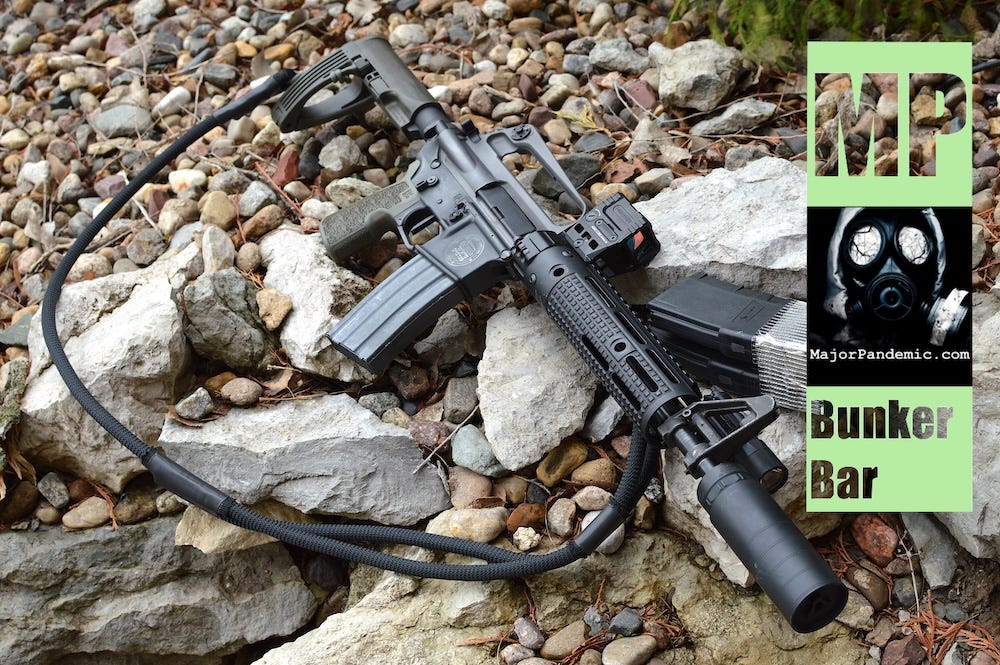


6.1 LB of fun and violence
Luth AR A1 Upper No shell Deflector
Unbranded AR Ambi Lower
Rise Armament Trigger
KAK Trigger Guard
Kung Fu Grip ODG
JP Ambi Selector (hacked)
LPM Duty 5.56 Suppressor
Faxon Duty 12.5 .625 barrel 5.56 Nato
Apex Tactical Handguard Mid Length with top rail
Gear Head Works Tail Hook Rear Assembly
Magpul QD Backplate
CMMG Parts Kit
WMD M16 NIBX BCG
Magpul Rail Light Attachment
Surefire Light
V7 Billet flat ejection port cover
MFT Israeli style coupler
XS Sight CSAT F/R Tritium sight
Custom 1/2 500lb shock cord Sling
Strike Charging handle (had it)
Custom Dimple Mounted F Front Sight with Adjustable gas block mod.


A few pictures here of the laser engraving, the magpul surefire mount that was a bit customized, the Holosun AEMS with Infatec Micro Thermal and a little of the shit show that is the Gaza strip.
Major Pandemic’s Bunker Bar (MajorPandemic.com): IDF Gaza Special “Mod 12” — The Modern Kutsar-Inspired M16A1 Carry Handle Build for Close Quarters and Red Zone Reality
In this Major Pandemic’s Bunker Bar episode on MajorPandemic.com, Major Pandemic goes full nerd mode on a decade-long passion project: the IDF Gaza Special Mod 12—a modern, practical evolution of the IDF Kutsar concept that keeps the M16A1 spirit alive while leaning into the real upgrades that show up on Israeli rifles today. This episode is part history, part build breakdown, and part love letter to the Israeli habit of continuously refining legacy AR platforms instead of treating them like museum pieces.
What the “IDF Gaza Special Mod 12” Is (and Why Major Pandemic Built It)
Major Pandemic frames the Mod 12 as a salute to the original M16A1 map-program inventory that’s still seen in Israeli use and in the broader IDF Kutsar lineage. He emphasizes that IDF weapon evolution isn’t rigid or standardized the way many people imagine—there are “guidelines,” but individual units and operators often bring their own stocks, grips, optics, and small upgrades into the mix. The result is a living ecosystem: some rifles are brutally retro (duct tape, chopped handguards, grenade launcher cutouts), while others look surprisingly modern with free-float rails, optics, lights, and upgraded triggers.
The Mod 12 is Major Pandemic’s answer to a question he’s been chasing for years:
If the Kutsar concept kept evolving through 2026, what would a logical, modernized version look like—without losing its heritage?
The IDF Context: Why Short ARs Still Matter Even With the X95
The episode makes it clear that yes, the IWI X95 is widely fielded and extremely common in the IDF because of its compact overall length with a full-length barrel. But Major Pandemic argues the AR platform still dominates specific tasks, especially in the kinds of tight, chaotic environments associated with “red zones.” His focus is on the sweet spot that keeps showing up in IDF photos and operator commentary: roughly 10.5–12.5-inch AR-pattern rifles as fast entry tools that can still stretch to real distance when the environment opens up.
His larger point: compact AR configurations didn’t become “cool” because of internet trends. They became popular because they solved real problems—tight hallways, weird angles, rapid transitions from point-blank to 300 yards and back again, and constant movement between bright sunlight and pitch-dark interiors.
The Build Philosophy: “Pirate Rules” + Israeli Practicality
Major Pandemic repeatedly returns to the idea that IDF-style rifles evolve like “pirate guidelines.” There’s no single “correct” version—just a continuously adapted toolset. He intentionally builds the Mod 12 with that mindset:
Keep the M16A1 heart and silhouette
Add upgrades that reflect real-world Israeli use today
Use what’s on the bench where possible, because that’s how a lot of real rifles get upgraded at the depot level
Core Specs: M16A1 Heart, 12.5-Inch Reality
At the center of the Mod 12 is an intentionally period-correct M16A1-style upper—teardrop forward assist, no shell deflector, and the classic fixed carry handle vibe. Instead of a modern pencil-taper profile, he chooses a 12.5-inch barrel that better matches the older continuous-profile look associated with early M16A1 barrels. This keeps the rifle visually and functionally anchored in the A1 world—while still delivering the maneuverability that made the IDF short carbines so effective.
The “Carry Handle + Forward Dot” Setup (and Why It’s So Fast)
One of the most SEO-relevant takeaways in the episode is his obsession with how fast a carry handle rifle with a forward-mounted red dot can be. Major Pandemic describes the carry handle as a weird cheat code: it “draws your eye” into the rifle and makes target pickup feel instant. He pairs that speed with a modern green-dot optic, and he describes the whole sighting system as insanely quick at realistic distances—especially with a fixed front sight and a lower-third co-witness style visual reference.
If you’re searching terms like carry handle red dot build, M16A1 optic setup, or A1 carry handle modernized, this episode is basically a masterclass in why that configuration still works.
Upgraded Iron Sights: Modern Low-Light Capability Without Losing A1 Simplicity
Major Pandemic explains why he upgrades the iron sights while still staying “in the spirit” of the platform. A1 peeps are tough and hold zero forever, but they’re not ideal in low light. His solution is an enhanced rear system with multiple reference options and a tritium front blade—keeping the ruggedness while making the rifle far more usable in real conditions.
Reliability Upgrades and “Use What’s On the Table” Parts
The Mod 12 is not a pure retro cosplay build. It’s a modernized working rifle with a few deliberate reliability choices:
A premium, slick-running bolt carrier group chosen for smooth cycling and practical reliability
A front sight base modified into an adjustable gas solution, built specifically around suppressor use and reducing gas blowback
A setup designed to run suppressed with compact 5.56 cans (he mentions options he plans to use), reinforcing the “modern IDF-adjacent” intent even if not every unit runs an adjustable gas solution
Free-Float Handguard: The “Modern IDF” Visual and Functional Shift
A major upgrade that defines the Mod 12’s “2026 evolution” angle is the move to a free-float handguard. He explains it the way operators do: if you’re mounting lights, lasers, clip-on night vision, or thermal tools—and you want them to hold zero—clamshell handguards become a limitation fast. The free-float rail gives:
better mounting real estate
better stability
better cooling/airflow during hard use
more flexibility for modern accessories
He also chooses a handguard with a distinctive “non-American” look to keep the rifle visually aligned with Israeli design language rather than typical U.S. clone aesthetics.
Lower Receiver and “IDF-Inspired Personalization”
Another signature detail: Major Pandemic builds the rifle with a clean, minimal-logo ambi lower specifically so he can personalize it. He talks through custom engraving choices and the broader theme that personal markings and identity scrawls are common on real rifles in theater—part culture, part ownership, part morale.
Real-World Performance: Fast, Balanced, and “A Sword That Wants to Be Wielded”
After the first range session, Major Pandemic’s verdict is blunt: the Mod 12 is one of the most fun builds he’s ever done, and it’s shockingly fast and accurate right out of the gate. He describes it as light, short, and balanced, with very little “extra crap” hanging off it—exactly the type of rifle that explains why compact ARs stayed relevant for decades.
He also connects the rifle back to the IDF environment it’s inspired by: dense urban layouts, unpredictable angles, vertical structures, tunnels, rapid light transitions, and engagements that can compress and expand without warning. The rifle’s role is versatility—something you can move with in tight spaces while still having the reach to work when distance suddenly appears.


