



Why the Firearms Industry Is Struggling: The Post-2020 Gun Sales Hangover No One Wants to Talk About
SEO Title: Why the Firearms Industry Is Struggling in 2026: Gun Sales, NICS Checks, Inventory Glut & the Post-2020 Hangover
Meta Description: The firearms industry is facing one of its toughest downturns in decades as post-2020 demand fades, NICS checks soften, inventory piles up, and manufacturers fight for fewer buyers.
Suggested URL Slug: why-firearms-industry-is-struggling-2026
Focus Keywords: firearms industry, gun sales, NICS checks, shooting sports industry, firearms market downturn, gun industry sales, firearm manufacturers, gun retailers, suppressor sales, firearms accessories
The Firearms Industry Is Not Dead — But It Is Absolutely in Trouble
Welcome back to Major Pandemic’s Bunker Bar, where the drinks are cold, the walls are reinforced, and the industry talk is brutally honest.
There is no soft way to say this: the firearms industry is struggling right now.
Not the Second Amendment. Not gun culture. Not shooting sports as a lifestyle. Those are still alive and well. But the actual business of selling new firearms, moving inventory, keeping manufacturers healthy, and keeping retailers profitable is in one of the roughest spots it has seen in decades.
The warning signs are everywhere: slow retail traffic, stacked distributor shelves, manufacturers fighting over the same shrinking demand, and accessory companies wondering where the next wave of customers is supposed to come from.
The problem is not that Americans suddenly stopped caring about guns. The problem is that the industry built itself for the boom — and the boom ended.
2020 Was the Peak, Not the New Normal
The firearms industry had an unbelievable run in 2020. Between COVID, riots, political uncertainty, personal-security concerns, and first-time buyers flooding the market, gun sales exploded.
NICS checks became the easiest public shorthand for that surge. They are not perfect, because a NICS check does not equal one gun sold, and not every firearm purchase requires a new background check. But they are still one of the best indicators of retail firearm demand.
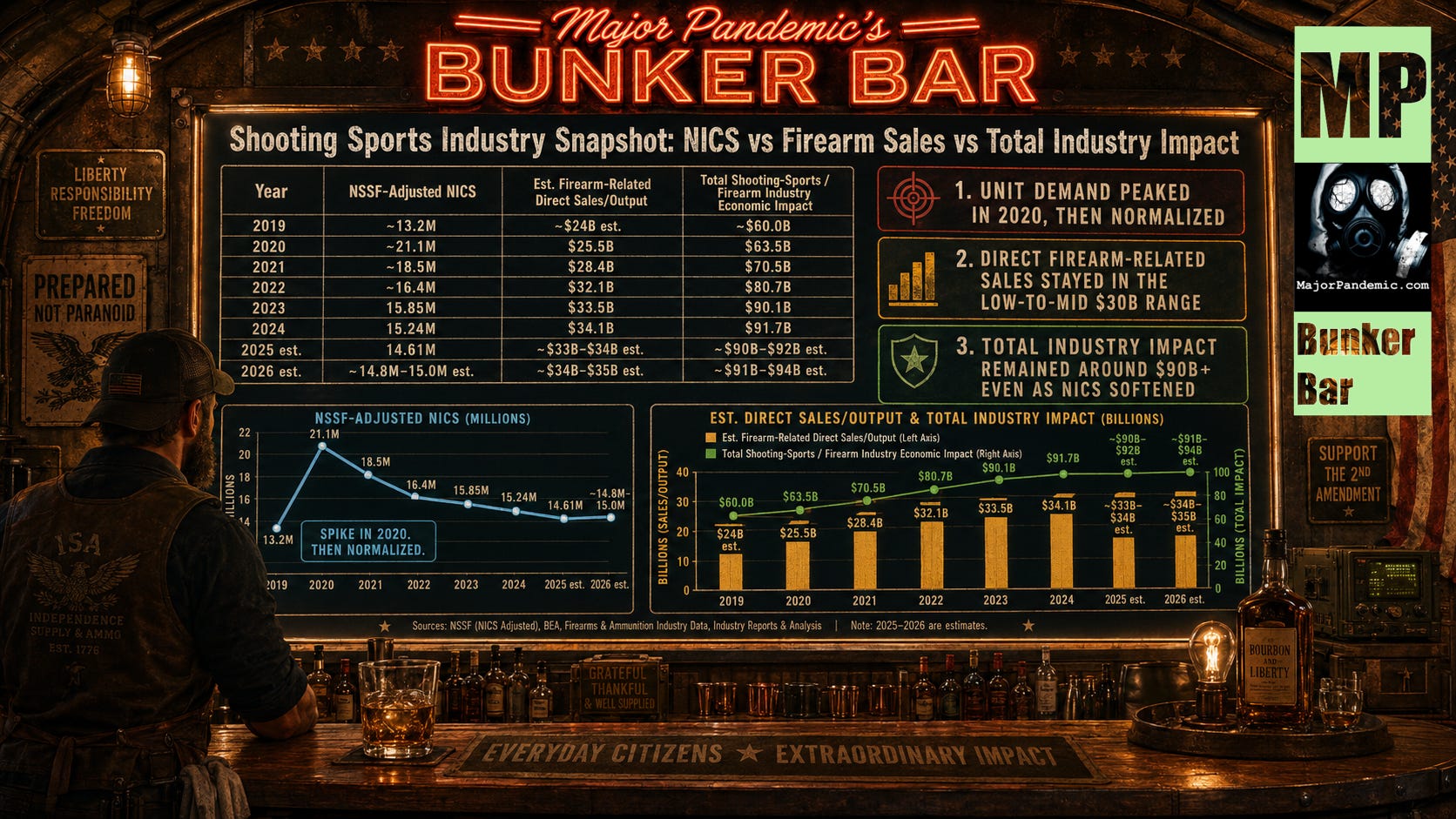
The rough trend tells the story:
YearEstimated NSSF-Adjusted NICS Checks2019~13.2M2020~21.1M2021~18.5M2022~16.4M2023~15.85M2024~15.24M2025~14.61M2026 est.~14.8M–15.0M
That means the industry is down roughly 25% to 30% from the 2020 boom peak based on NICS-driven demand indicators.
That is a massive drop.
But here is where the story gets more complicated: the broader shooting sports industry can still look strong in dollars while firearm unit demand is clearly down.
The Dollar Numbers Can Be Misleading
Some people look at the shooting sports industry and say, “What are you talking about? The industry is up. The economic impact is huge.”
That is partly true — but it depends which number you are looking at.
There are really three different things people mix together:
NICS checks — a proxy for firearm transaction volume.
Firearm-related direct sales/output — closer to actual commercial revenue from firearms, ammo, accessories, retail, and related channels.
Total shooting sports economic impact — the broader economic footprint, including jobs, wages, suppliers, taxes, and downstream spending.
Those are not the same thing.
A cleaner view looks like this:
YearNSSF-Adjusted NICSEst. Firearm-Related Direct Sales/OutputTotal Shooting-Sports / Firearm Industry Economic Impact2019~13.2M~$24B est.~$60.0B2020~21.1M$25.5B$63.5B2021~18.5M$28.4B$70.5B2022~16.4M$32.1B$80.7B202315.85M$33.5B$90.1B202415.24M$34.1B$91.7B2025 est.14.61M~$33B–$34B est.~$90B–$92B est.2026 est.~14.8M–15.0M est.~$34B–$35B est.~$91B–$94B est.
This is the heart of the confusion.
NICS checks are down. Firearm unit demand is down. But total industry dollars are not down the same way because prices are higher, accessories are still selling, suppressors are hot, training is strong, and the total economic-impact number includes far more than guns sold at retail.
So yes, the shooting sports industry can look healthy on a macroeconomic chart while many firearm manufacturers and retailers are getting crushed in the real world.
The Industry Overbuilt for a Boom That Did Not Last
The biggest mistake was assuming 2020 was a new baseline.
It was not.
A lot of manufacturers looked at the 2020 surge and expanded production. More machines. More employees. More buildings. More inventory. More SKUs. More everything.
Then the wave disappeared.
By late 2021, the market had already started normalizing. The panic demand was gone. First-time buyers had made their purchase. Political fear cooled. Retail traffic slowed. But the production capacity was already built.
That is how the industry ended up with firearms sitting on manufacturer shelves, distributor shelves, and retailer shelves.
Too many guns. Too many similar products. Too many companies chasing too few active buyers.
The Used Gun Market Is Also Hurting New Gun Sales
Another overlooked issue is the flood of used guns coming back into the market.
Older gun owners are selling off collections. Some buyers who entered the market during 2020 are not becoming repeat buyers. Others are trading instead of buying new.
That creates a problem for manufacturers: a used gun sale may help a retailer or transfer dealer, but it does not help the manufacturer move new inventory.
It also gives budget-conscious buyers an alternative. Instead of buying a new rifle, shotgun, or handgun, they can buy something used, refinish something they already own, or spend money upgrading what is already in the safe.
That is one reason services like Cerakote, customization, and gunsmithing can still be busy while new firearm sales struggle.
The Generational Problem Is Real
The gun industry also has a demographic problem.
Boomers already own a lot of firearms. Many are slowing down, selling extras, or becoming more selective.
Gen X is probably the strongest remaining repeat-buyer group because they have the income, interest, and practical use cases. But there are not enough Gen X buyers to rescue every manufacturer.
Older Millennials are becoming more meaningful buyers, but many are still under pressure from housing costs, inflation, debt, and family expenses.
Gen Z has interest, but they are not yet in a position to replace the spending power of Boomers and Gen X. Many are younger, lower-income, more experience-driven, and less likely to be heavy product collectors at this stage.
That leaves the industry stuck between an older buyer base that is saturated and younger buyers who are not yet able or willing to spend enough to fill the gap.
No Panic Buying Means No Artificial Demand
For years, the industry benefited from fear-driven buying cycles.
Election years. Regulatory threats. Riots. Magazine bans. Assault weapon ban chatter. Shortages. Supreme Court fights. ATF uncertainty.
When people believed they might lose access to certain firearms, they bought immediately.
Right now, the environment is different. Many gun owners feel politically safer. They may still care about court cases, executive orders, ATF interpretations, pistol braces, forced reset triggers, suppressors, and NFA reform, but the average buyer is not acting like everything must be purchased today.
That is good for constitutional confidence, but bad for panic-driven sales.
The industry is learning a hard lesson: you cannot build a healthy long-term business model around people being afraid.
Some Categories Are Getting Destroyed While Others Are Still Working
The pain is not evenly spread.
Traditional AR-15s, standard black rifles, pump shotguns, basic rifles, and commodity products are under heavy pressure. Some categories appear to be down dramatically from the boom years.
But other categories still have energy:
Suppressors
Pistol-caliber carbines
Innovative defensive handguns
Premium 2011-style pistols
Custom guns
Cerakote and refinishing
Training
Female-focused shooting accessories
Optics and accessories tied to new platforms
The key difference is innovation.
The companies doing better are not simply making another version of the same thing everyone else already sells. They are offering a new angle, a premium experience, a specialized product, or something that gives buyers a reason to spend.
The “me too” manufacturers are the ones in danger.
Suppressors Are Masking Some of the Pain
One of the brightest spots right now is suppressors.
A lot of disposable firearm dollars are flowing into suppressors because the wait times, tax-stamp discussions, legal momentum, and product innovation have created real demand.
For many enthusiasts, suppressors have gone from a rare special purchase to a normal part of the collection.
That is great for suppressor manufacturers, dealers, and related accessory companies. But it can also mask the broader problem. Money going into suppressors is not always money going into new rifles, shotguns, handguns, optics, or traditional accessories.
Suppressors are helping the industry, but they are not fixing the entire firearms market.
Female Shooters Are One of the Strongest Bright Spots
The growth of female shooters may be one of the healthiest long-term trends in the shooting sports industry.
Female buyers often approach purchasing differently. Instead of simply buying a gun and figuring out the rest later, many think in terms of the whole solution: firearm, carry method, storage, training, accessories, range comfort, safety, confidence, and personal fit.
That creates strong opportunities across accessories, education, apparel, bags, holsters, optics, and training.
This is one reason the broader shooting sports market can remain healthier than the pure firearm-sales market.
New shooters do not only buy guns. They buy the ecosystem.
Why Accessory Companies Are at Risk
Accessory companies tied directly to new firearm purchases are in a dangerous position.
If people are not buying as many new rifles, they may not be buying as many new optics, rails, triggers, grips, slings, lights, cases, or upgrades for those guns.
The more an accessory company depends on a net-new firearm purchase, the more vulnerable it is.
Lifestyle accessories, bags, belts, apparel, training, and general shooting gear may hold up better because they are not always tied to a new gun sale. But direct firearm add-ons can suffer badly when the new firearm pipeline slows.
That is why some insiders are worried that a meaningful percentage of firearm-related accessory manufacturers may not survive the next few years if demand does not rebound.
The Industry Has Three Possible Lifelines
There are really only three ways out of this downturn.
1. A Major Demand Event
A large political, legal, social, or security event could trigger another buying wave.
That is not something anyone should hope for, but historically it is one of the things that moves firearm demand quickly.
2. Market Consolidation
This is the harsh economic answer.
If too many companies are chasing too few buyers, some companies will go out of business. That would reduce supply, reduce competition, and send more dollars back to the survivors.
It is ugly, but it is how overloaded markets eventually correct.
3. Innovation That Creates New Demand
This is the best answer.
Manufacturers need to stop assuming buyers will show up for another generic product. The market needs genuinely interesting firearms, better experiences, better marketing, better retail execution, smarter production planning, and products that make people excited again.
The winners will be companies that know who they serve, forecast honestly, innovate aggressively, and avoid building inventory nobody asked for.
What Buyers Can Do Right Now
If you care about the firearms industry, the simple answer is this:
Buy something.
Not because you are panicked. Not because someone told you to hoard. But because healthy industries need active customers.
Buy a firearm you have been meaning to pick up. Buy ammo. Buy a suppressor. Buy training. Buy from a local gun shop. Buy accessories from a small manufacturer. Support the companies doing good work before the market shakeout wipes them away.
The 250th anniversary of America is a perfect moment to celebrate the Second Amendment in a practical way. Not just with slogans, but by supporting the businesses that keep the shooting sports world alive.
Final Takeaway: The Shooting Sports Industry Is Stronger Than Gun Sales Alone
The firearms industry is down, but the broader shooting sports industry is not broken.
That distinction matters.
Gun sales are down from the 2020 peak. NICS checks are down. Commodity firearms are under pressure. Retailers are sitting on inventory. Distributors are packed. Manufacturers that overbuilt are hurting.
But shooting sports participation, suppressors, training, accessories, female shooters, customization, and premium innovation are still creating opportunity.
The industry does not need another panic bubble. It needs discipline, smarter forecasting, better products, and customers willing to support the businesses they want to see survive.
Because if buyers stay home long enough, a lot of familiar names may not be around when the next wave finally comes.


